
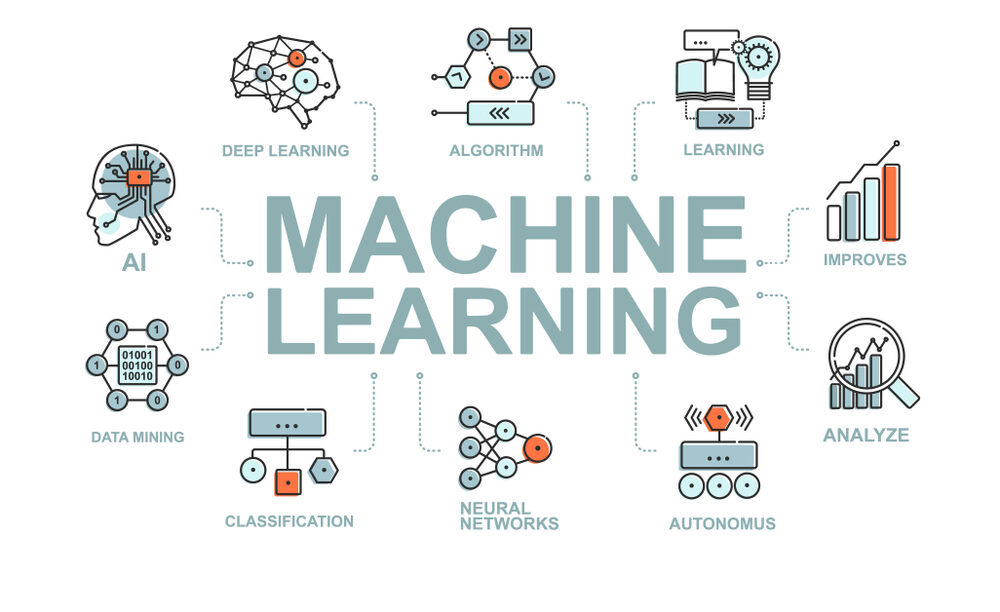
Machine learning is a subfield of artificial intelligence that involves training algorithms to learn patterns from data and make predictions or decisions without being explicitly programmed. There are three main types of machine learning: supervised learning, unsupervised learning, and reinforcement learning.
- Supervised Learning: Supervised learning is a type of machine learning in which the algorithm is trained on labeled data, where the desired output is known for each input. The goal of supervised learning is to learn a function that can map inputs to outputs accurately. Examples of supervised learning include:
- Regression: A type of supervised learning in which the algorithm is trained to predict a continuous output, such as the price of a house based on its size, location, and other features.
- Classification: A type of supervised learning in which the algorithm is trained to predict a discrete output, such as whether an email is spam or not based on its content and other features.
- Unsupervised Learning: Unsupervised learning is a type of machine learning in which the algorithm is trained on unlabeled data, where the desired output is not known. The goal of unsupervised learning is to discover patterns and structure in the data without any prior knowledge. Examples of unsupervised learning include:
- Clustering: A type of unsupervised learning in which the algorithm groups similar data points together based on their features, such as grouping customers into segments based on their buying behavior.
- Dimensionality reduction: A type of unsupervised learning in which the algorithm reduces the number of features in the data while preserving as much of the original information as possible, such as compressing an image while retaining its visual content.
- Reinforcement Learning: Reinforcement learning is a type of machine learning in which the algorithm learns to make decisions based on feedback from the environment, such as rewards or penalties. The goal of reinforcement learning is to learn a policy that maximizes the cumulative reward over time.
Some popular machine learning algorithms include linear regression, logistic regression, k-nearest neighbors, decision trees, random forests, support vector machines, and neural networks. These algorithms can be used for various tasks such as prediction, classification, clustering, and anomaly detection.
Overall, machine learning is a powerful tool that can be applied to a wide range of problems in various domains such as healthcare, finance, transportation, and entertainment. With the growing availability of data and computing power, machine learning is becoming increasingly important in many fields.
There are several popular machine learning frameworks available, and the best framework for you will depend on your specific needs and preferences. Here are some of the most popular machine learning frameworks:
- TensorFlow: TensorFlow is an open-source machine learning framework developed by Google. It supports a wide range of tasks, including image and speech recognition, natural language processing, and reinforcement learning. TensorFlow is known for its scalability and performance, and it is widely used in both research and industry.
- PyTorch: PyTorch is an open-source machine learning framework developed by Facebook. It is known for its ease of use and flexibility, and it has gained popularity in the research community due to its dynamic computational graph feature, which allows for more efficient model training.
- Scikit-learn: Scikit-learn is an open-source machine learning library for Python. It provides a wide range of algorithms for classification, regression, clustering, and dimensionality reduction, as well as tools for model selection and evaluation.
- Keras: Keras is an open-source deep learning library that runs on top of TensorFlow or Theano. It provides a user-friendly API for building and training deep neural networks, and it has gained popularity due to its ease of use and versatility.
- Caffe: Caffe is a deep learning framework developed by Berkeley AI Research (BAIR). It is designed for speed and efficiency, and it is widely used for image and video recognition tasks.
- Microsoft Cognitive Toolkit (CNTK): CNTK is a deep learning framework developed by Microsoft. It is known for its scalability and performance, and it supports a wide range of deep learning algorithms and models.
 Sandeep Palod